By Eva Strang, Chief of Staff, XeleratedFifty
So much of what appears in my news feed today is about the future: the transformative potential of AI, the shifting geopolitical landscape, the urgency of decarbonisation and the race to secure resilient supply chains. The future is coming fast. In many of these articles there seems to be an implicit assumption that innovation is inevitable, a natural force that magically manifests when a technology is ready. In my experience, the reality is far more nuanced. In the world’s most complex and critical industries, even the most extraordinary technological advances do not translate automatically into meaningful change. True innovation is hard. It demands not only engineering excellence but a deep understanding of human behaviour, enterprise culture and the deliberate engineering of systems, incentives and partnerships.
Hard as all of this is, when we get it right, the benefits are enormous.
We see this every day at XeleratedFifty, where helping breakthrough ideas develop and thrive inside complex industrial systems is both the challenge and the reward.Our mission is to accelerate innovation in the sectors that keep nations running and underpin global security. We began by launching Boeing’s global accelerator and innovation programmes, building a model that blends investment, incubation and hands-on portfolio development. Today, as an independent company, we partner with corporates, investors and governments around the world to source, scale and commercialise solutions that deliver measurable, system-level impact.
Over the years, we have learned that innovation in these industries does not succeed through enthusiasm alone; it requires structure, persistence and strategic intent. But before I share some of the hard-won lessons on how to make that happen, it is worth stepping back and asking a more fundamental question: why does getting innovation right in these industries matter so profoundly?
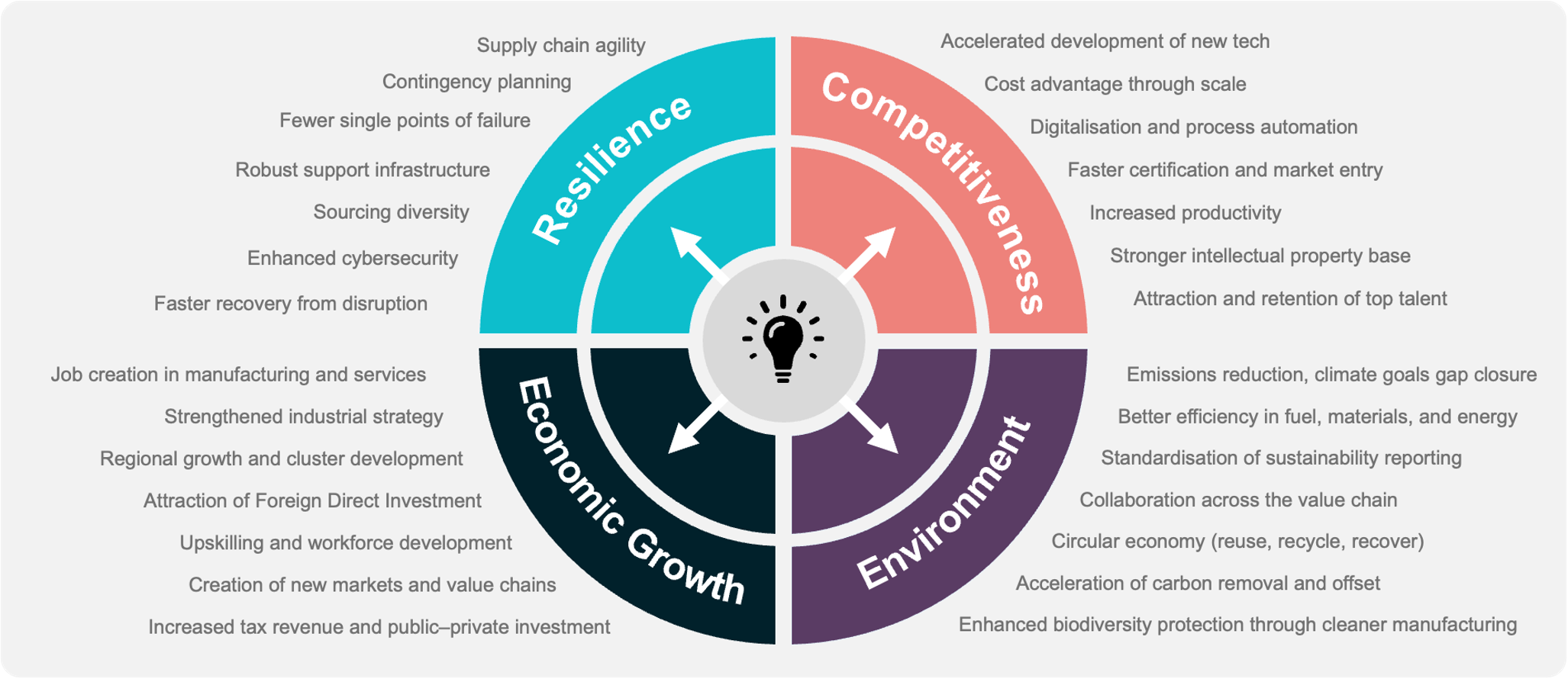
When we successfully introduce, scale and embed innovation in complex industries, the benefits extend far beyond individual technologies or programmes. They cascade across four interconnected dimensions: Resilience, Competitiveness, Environmental progress and Economic Growth. These sectors sit at the heart of national capability, so when they innovate effectively, supply chains become more agile, economies become more productive, environmental goals become more attainable and regions become more prosperous. The effects of effective innovation ripple outward beyond industry and into society as a whole.
Source: XeleratedFifty methodology
Let’s look at each of these four dimensions in a bit more detail
Strengthening national resilience: The global operating environment has become more volatile. Supply chain disruptions, energy insecurity, geopolitical shifts and climate-driven shocks are forcing leaders in business and government to rethink the robustness of their systems. Complex industries sit at the centre of this challenge, and innovation is one of the most powerful ways they can build resilience. New technologies make systems smarter, safer and more adaptive. They enable real-time data, predictive insight and better decision-making long before a potential crisis hits. Whether it is advanced materials that reduce dependency on constrained supply chains or digital tools that improve operational uptime, innovation strengthens resilience at every level. In uncertain and changing times with rapidly-changing technologies and new kinds of threats, resilience is increasingly a strategic necessity.
Enhancing global competitiveness: Complex industries operate on long cycles, high barriers to entry and intense international competition. Technological advantage accumulates over years, not months, and the decisions leaders make today shape capability for the next decade and beyond. Innovation plays a central role in maintaining that edge. New technologies shorten development timelines, improve reliability and expand the envelope of what organisations can deliver. Digitalisation, automation and advanced engineering tools help teams work with greater precision and speed. Faster certification pathways, improved data flows and more efficient production systems create productivity gains that compound over time. These shifts strengthen industrial capability and position companies and countries to compete in global markets where expectations and standards continue to rise.
Accelerating environmental progress: Complex, hard-to-abate industries are foundational to our societies, yet they also drive a large share of the world’s emissions. Innovation provides practical pathways to close this gap. Advances in fuels, materials, energy systems and optimisation tools offer meaningful reductions today and open the door to deeper decarbonisation tomorrow. Breakthroughs in electrification, hydrogen propulsion, circular manufacturing and digital efficiency models allow organisations to redesign operations with far lower environmental impact.Collaboration across value chains — supported by clearer sustainability reporting and shared standards — helps these solutions scale across sectors rather than remain isolated successes.
Driving economic growth and prosperity: Complex industrial sectors anchor national economies. They support high-skilled jobs, stimulate advanced manufacturing, attract investment and shape regional clusters. When innovation gains momentum, these benefits extend even further. New technologies create specialised supply chains and open new markets. They encourage private investment and strengthen industrial strategy by building capabilities that endure across economic cycles. Regions with strong innovation ecosystems attract talent, foreign direct investment and long-term commercial partnerships. They also generate opportunities for upskilling, workforce development and new value creation. Economic growth in these sectors comes from continuous renewal — the steady introduction of technologies that make industries more productive, more diverse and more globally connected.
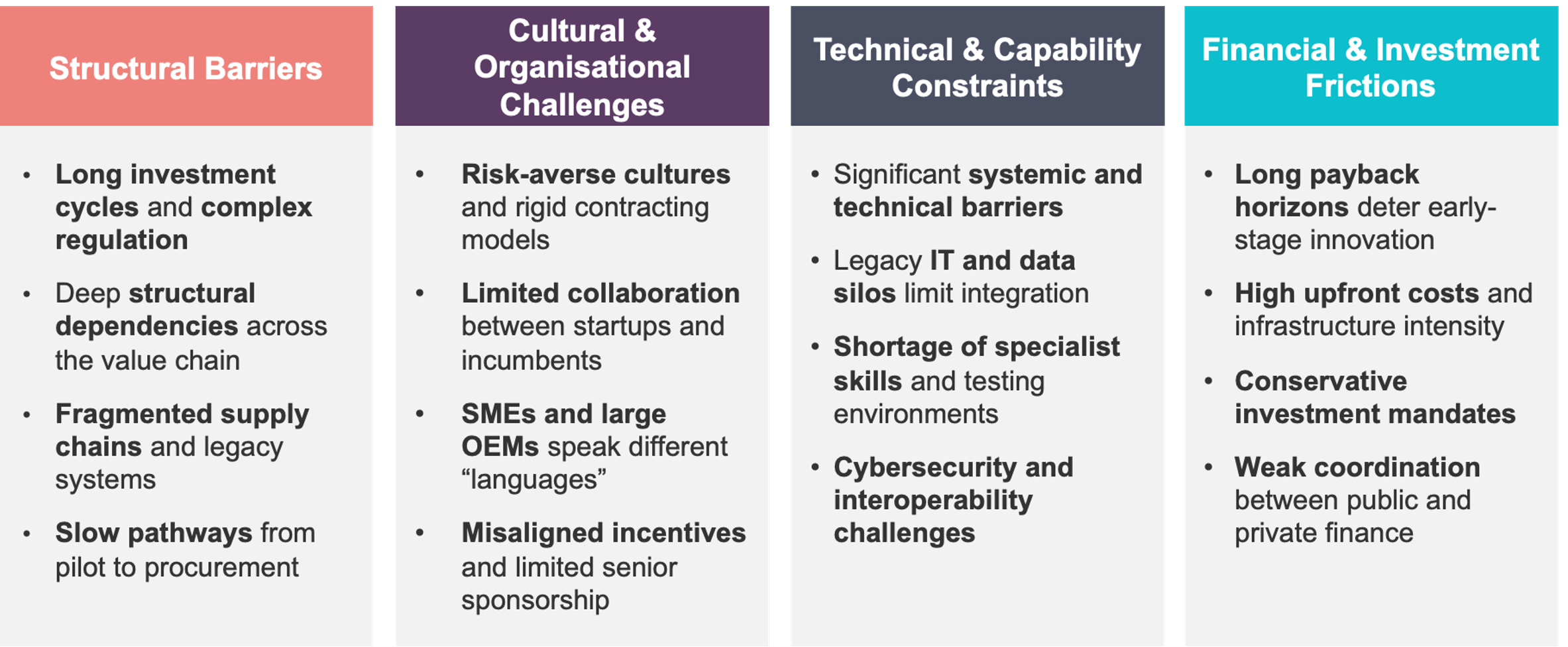
With such clear benefits, why is innovation so challenging in these industries? The difficulty is structural. These sectors are rightly engineered to minimise risk. Safety, reliability and compliance are non-negotiable, but they also slow the pace at which new technologies can be tested, qualified and adopted.
Long investment cycles, conservative engineering cultures, regulatory constraints and the infamous pilot-to-procurement gap all create friction. Startups and incumbents often operate with entirely different assumptions and vocabulary.One values iteration; the other values documentation. Without translation, collaboration collapses before it begins.
Innovation is hard not because people resist it, but because the system around them was never designed to absorb rapid change.
After years in this space, and with a strong track record of successfully driving change in complex industries, we have learned the hard way what makes the difference in embedding and scaling promising innovations. Every situation is unique, but below are some of the most important and universal lessons:
Plan for scale from the start: Innovation gains momentum when the pathway is clear. Pilots need more than technical success; they need a route through certification, procurement, integration and long-term support. These steps determine whether a technology can operate safely and reliably inside real systems. The earlier they are understood, the faster progress becomes. Organisations that map the path to scale at the outset avoid the common fate of strong pilots that cannot move into operational use.
Bridge ecosystems, not just organisations: Complex industries depend on coordination. Startups, corporates, investors, regulators and government agencies each hold part of the solution, and progress relies on bringing those parts together. Innovation advances when expectations are aligned — on timelines, on risk, on evidence, on decision-making. Effective translation across these groups turns isolated activity into collective momentum. The strongest breakthroughs emerge where these ecosystems genuinely connect.
Deploy patient, flexible capital: Deep-tech innovation moves at the pace of engineering. Certification cycles, qualification processes and industrial scaling all demand time, and technology fails when the capital behind it cannot support that reality. Funding that adapts to long development timelines, variable risk profiles and complex commercial milestones gives teams the stability to refine, test and prove solutions in demanding environments. Patient capital is often the difference between technologies that endure and technologies that fade.
Prioritise trust and transparency: Progress depends on confidence — in the technology, in the data and in the teams behind it. Leaders need to understand performance, risks and trade-offs with clarity. When communication is open and evidence is shared early, decision-makers move faster because they understand exactly what they are adopting. Transparency builds credibility, and credibility builds alignment. In complex programmes where many stakeholders sit at the table, trust is often the decisive accelerant.
Focus on measurable outcomes: Innovation is valuable when it creates impact that can be demonstrated and repeated. Clear metrics — whether related to resilience, emissions, capability or cost — keep teams focused on what matters most. Measurement also helps technologies progress through procurement and regulation, where evidence is essential. Organisations that anchor their innovation efforts in outcomes consistently see stronger adoption and stronger returns.
When these principles come together, innovation becomes a source of real advantage.Industries move faster, systems become stronger and countries build capabilities that endure. In complex sectors, this alignment is what turns potential into progress.
The opportunity in front of us is extraordinary. Many of the technologies that will shape the next industrial era are already here. The challenge is creating the pathways, partnerships and investment models that allow them to scale safely and effectively. Progress depends not just on invention but on integration — and on the collective will to move promising solutions into real systems.
That belief that when innovation succeeds, societies succeed is one of the reasons I chose to build my own career in this space. There are few things more motivating than seeing anew technology shift what is possible for an entire country. The potential impacts are profound: stronger national resilience, sharper global competitiveness, faster environmental progress and more dynamic, future-ready economies. These outcomes are within reach when the right capabilities and the right collaborators come together.
At XeleratedFifty, we see the power of this collaboration every day. We have the privilege to work alongside some of the most forward-thinking corporates, OEMs, government agencies, innovators and investors in the world. Our role is hands-on. We combine investment, acceleration and incubation with the heavy lifting of portfolio development —working closely with teams to prepare technologies for enterprise-grade adoption and long-term commercial success. This integrated approach gives innovations the support they need to survive inside complex environments and, ultimately, to scale.
For leaders across government and industry, the question is no longer whether innovation matters. It is how to build the conditions that allow it to take root: strong partnerships, clear pathways, aligned incentives and the right mix of capital and capability. These are foundational to progress, and they are the principles that guide our work every day.
The future will not invent itself. We have to accelerate it, together.