by Nichola Quinn
While 2025 had many warning signs,2026 has been definitive. The mood at Davos and Munich this year signalled the final nail in the coffin of the globalist optimism that once anchored many industrial strategies. At theWorld Economic Forum, Canadian Prime Minister Mark Carney was characteristically direct: "We are in the midst of a rupture, not a transition... Nostalgia is not a strategy." Then, at the Munich Security Conference, U.S. Secretary of State Marco Rubio’s address moved beyond the typical defence rhetoric to focus on the industrial base. He spoke of the "dangerous delusion" that trade alone would replace nationhood, and called for the creation of Western supply chains that are "not vulnerable to extortion from other powers."
For those of us working in foundational sectors like aerospace, energy, maritime, and advanced manufacturing, these words hit hard, and the takeaways are stark. We are no longer navigating a temporary shift in the rules-based order, we are managing its rupture. The old world of frictionless global supply chains is not coming back any time soon. The language of “cooperation” has been replaced “competition” and “sovereign capability.” Gone are the days of an integrated global market. We’re now navigating a world of geopolitical friction and rapid reconfiguration of supply chains. The harsh reality is that if you cannot build, maintain and modernise within your own sphere of influence, you are strategically exposed.
In this climate, driving innovation in critical industries often slips well down the list of priorities – while this is understandable, it is actually a grave mistake. Being able to innovate successfully in complex sectors is a fundamental requirement for industrial survival and for national resilience.
There is often an underlying assumption that innovation is a linear, automatic process. The idea that a superior technology, process or idea will naturally find its way onto the assembly line. Across my career in complex, safety-critical sectors, and more recently through XeleratedFifty’s work scaling frontier technologies, I have witnessed first hand that innovation is hardly ever a straight line from idea to industrialisation. In complex, hard-to-abate sectors, innovation is actually exceptionally hard to achieve.
These organisations were often designed for stability, safety, and incremental improvement. They were never intended to absorb rapid, exogenous change. When we attempt to introduce "outsider" innovation into these sectors, we immediately come up against a corporate immune system designed to detect and neutralise risk. To succeed, we need to understand the"What" of the technology while also mastering the "How" of the organisations involved.
If technical excellence were the only requirement, the industrial landscape would look very different. However, driving and embedding innovation successfully requires a deep intuition for human behaviour, enterprise culture, and the subtle architecture of incentives.
This requires a shift in perspective from both the enterprise and the innovator. The large-scale engineering firm must learn to be a "sophisticated buyer"—one that understands how to de-risk a partnership with a startup without crushing it under the weight of traditional procurement. At the same time, the entrepreneur must understand that now matter how bright their technical brilliance shines, they also have to dedicate time, patience and resources to understanding the way things are done in a large critical enterprises, and securing the industrial fit.
The innovation’s value must be understood and explained in terms of its impact across the entire enterprise. What are the actual incentives for a Programme Lead ora Certification Engineer to adopt a new technology? In large critical industries, new ideas are often seen more in terms of their risk, than their potential benefit. The personal and professional cost of a failure far outweighs the reward of a breakthrough. If the system is set up to rewards the status quo and punishes even a calculated failure, innovation will always remain stuck in the "pilot phase." Bridging this gap requires more than a contract; it requires a partnership built on empathy, technical credibility, and a shared understanding of the operational reality.
At XeleratedFifty, much of our work sits precisely at this junction — aligning entrepreneurs, long-term capital and industrial operators around practical pathways to scale. The technical problem is rarely the limiting factor. The organisational one usually is.
It was clear from the tone of the conversations in Munich that security is expanding to include the resilience of factories, energy infrastructure, access to critical minerals. It follows that global outsourcing based on cost alone is quickly being replaced by a drive towards "Sovereign Capability."
This disruptive shift presents generational challenges and opportunities for the engineering sector. There is a decisive opening to redefine industrial capability. The challenge is multi-layered, requiring alignment of technical pedigree, visionary leadership, and a commitment to modernisation at pace. Success now depends on establishing digital continuity, creating "digital threads" that link design, production, and maintenance into a single source of truth, as well as deploying AI-first technology as a fundamental productivity multiplier across the entire industrial lifecycle.
By localising high-value manufacturing and using additive manufacturing to compress development cycles, we can bridge the gap between "building local" and "acquiring faster." This is about ensuring that if a geopolitical shock hits tomorrow, our industrial engine does not grind to a halt.
Predictable times allow us to build in a steady incremental way. Unpredictable times demand vision. The leaders who will shape the next industrial cycle will be the ones who recognise that the global landscape has fundamentally shifted and move with purpose. This means building partnerships based on shared risk and technical reality, rather than administrative checklists.
At XeleratedFifty, we spend a lot of our time acting as a catalyst, joining the dots, and bridging the gaps between capital, capability, and adjacent industries. We have the capabilities, experience and contacts to source, scale, and commercialise breakthrough technologies in complex, high-impact industries. But we don’t do it alone. If any of this resonates with you, please get in touch and let’s start a conversation.
The next industrial cycle will be shaped by those who find paths to successfully drive innovation and modernise complex and critical systems while they are live. This is how we will engineer the future of our national resilience.
--
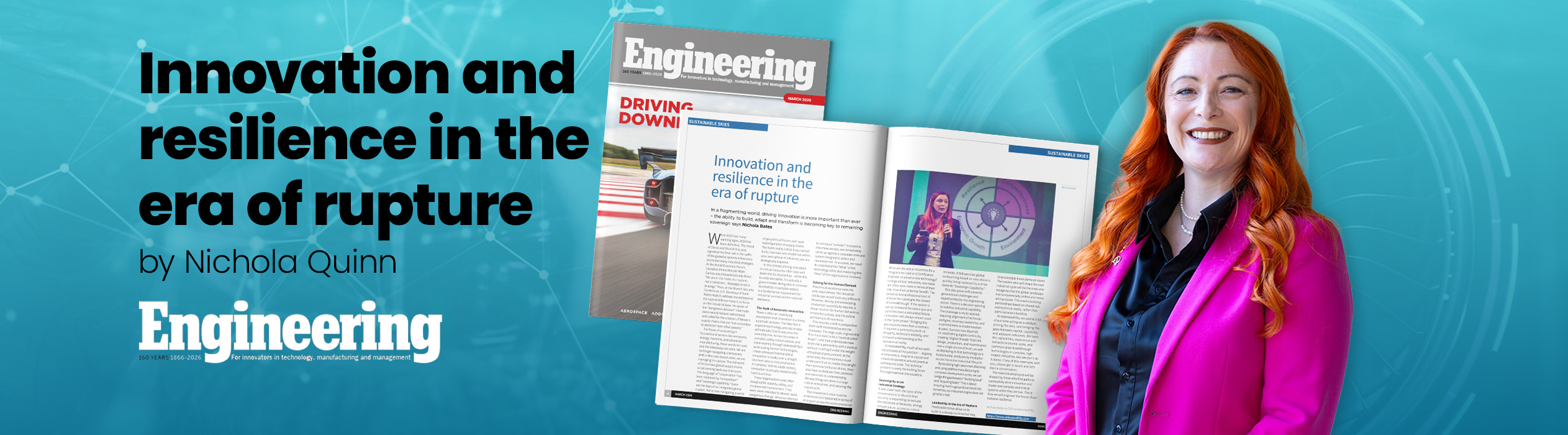
This article was originally published in Engineering Magazine.